
Emergency Roof Repair Near Me: What San Antonio Homeowners Should Do First
If water is coming through your ceiling right now, your first move is simple: stop the water from spreading, document where it’s entering, then call a professional. Most San Antonio homeowners who try to fix a roof breach themselves make the damage worse, and the 90 minutes after a breach determines whether you’re filing a manageable insurance claim or replacing ceiling drywall throughout your home. If you’d rather not handle this alone, Ridgeline Roofing Co. of San Antonio has a live person answering calls at (833) 756-5022, 24 hours a day.
The single most expensive mistake we see isn’t ignoring the leak. It’s moving furniture and mopping floors without documenting the water’s path first. That documentation is exactly what your insurance adjuster needs to approve a full claim. Here’s the calm, sequential plan we give our own neighbors in Alamo Heights, Stone Oak, and the Medical Center when they call us in the middle of a storm.
First 15 Minutes: Stop the Spread, Protect Yourself
Water moves fast in a San Antonio home, especially with our clay-heavy soils that shift and stress roof decking over time. Your job in the first quarter hour isn’t to fix anything. It’s to contain and observe.
Do this in order:
- Turn off electricity to affected areas. Water finds the path of least resistance, and in older San Antonio homes, that path often runs near electrical panels, recessed lighting housings, or attic junction boxes. If your breaker panel is in a dry area, shut off circuits to the wet zone. If the panel itself is wet or you smell burning plastic, stay clear and call the fire department’s non-emergency line.
- Move valuables and create a channel. Lift furniture legs onto aluminum foil or plastic. Poke a small hole in any ceiling bulge that’s forming, and place a bucket directly beneath it. This seems counterintuitive, but a controlled drain prevents the drywall from saturating and collapsing across a wider area.
- Photograph everything before you touch it. Take wide shots showing the room layout, then close-ups of the water entry point on the ceiling, any wall staining, and the floor beneath. These first images establish the timeline that adjusters use to separate pre-existing damage from storm damage.
Do not go into your attic yet. Wet insulation hides nails, and the structural integrity of your ceiling is compromised. We’ve responded to calls in Terrell Hills where a homeowner stepped through a saturated drywall panel trying to find the source.
First Hour: Document the Breach for Insurance
After the immediate threat is contained, your next task is building a claim file that moves fast through your adjuster’s queue. In our 42 years of serving San Antonio, the claims that get approved quickly share one trait: they tell a clear visual story.
Photo sequence that works:
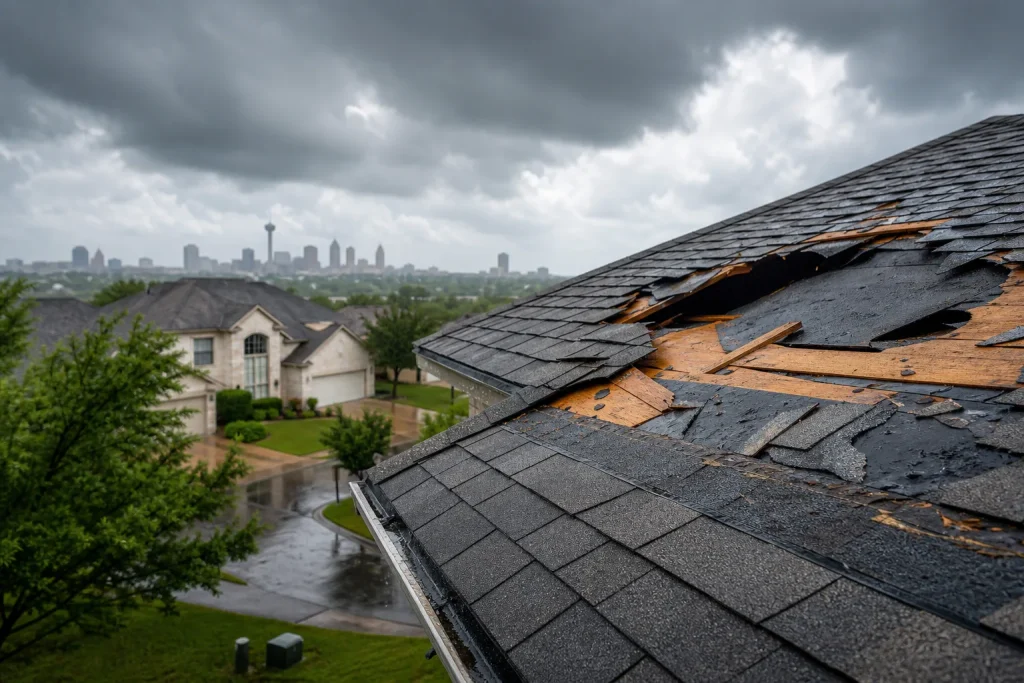
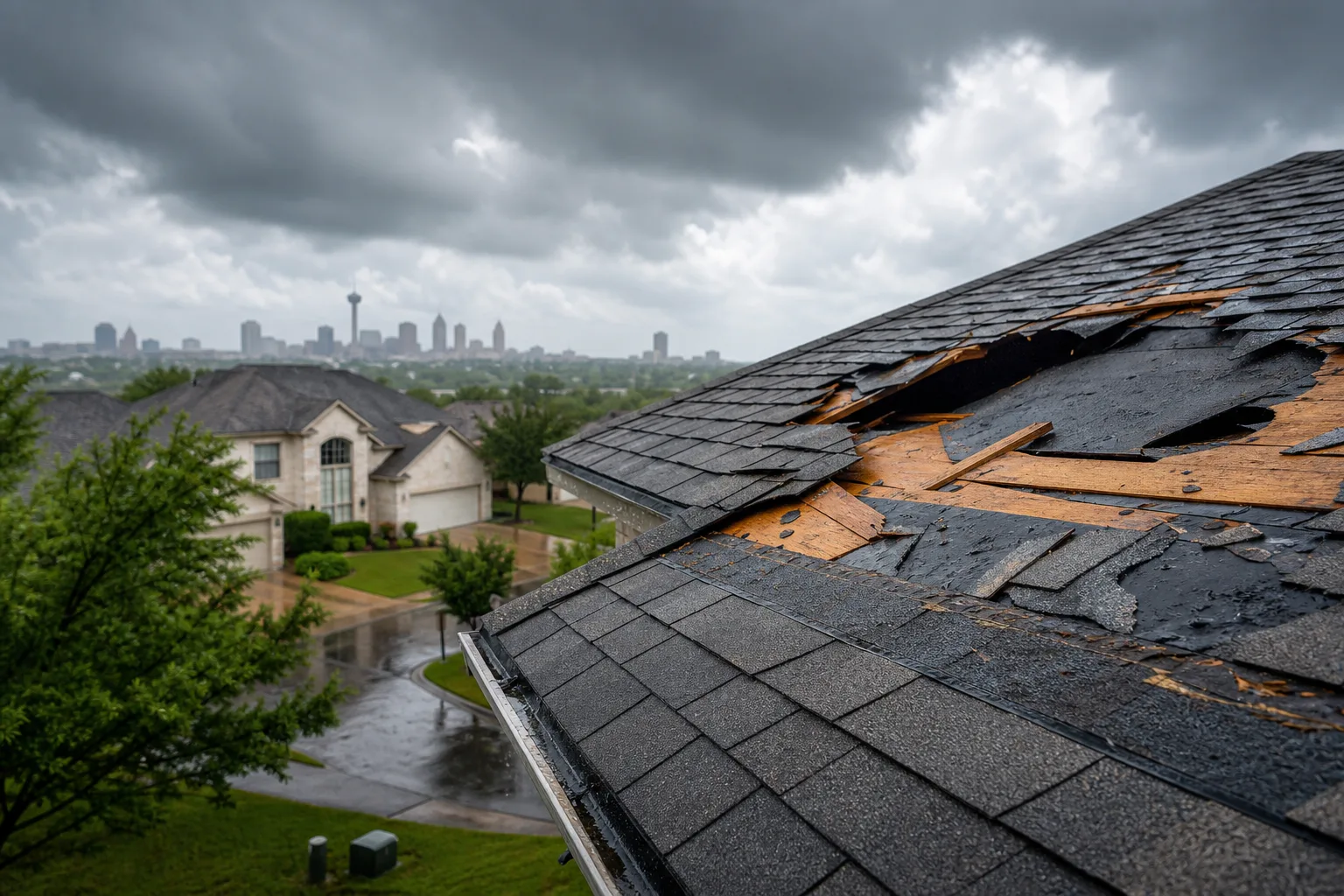
- Exterior wide shot: Your roof from the street or yard, showing the general condition and any visible damage to shingles, flashing, or vents.
- Ground-level debris field: Shingle granules, broken tile pieces, or tree branches on the ground. This proves the storm’s intensity at your specific address.
- Close-up of the breach: From a safe position on a ladder or through a zoom lens, capture the damaged area with surrounding intact material for scale.
- Interior damage progression: The original entry point, any spreading stains, and affected contents with date-stamped photos.
Write down: the time you first noticed water, the storm event that preceded it (hail, wind gust, falling branch), and any temporary measures you’ve taken. Adjusters in Bexar County tell us this written timeline saves them hours of investigation, and that speed gets your check issued faster.
Keep your photos in a dedicated folder. Do not edit, crop, or filter them. Insurance software flags altered images, and a legitimate claim can get delayed over a simple contrast adjustment.
Before Nightfall: Tarping That Actually Holds
San Antonio weather turns fast. A morning thunderstorm can give way to 40-mile-per-hour winds by evening, and a poorly secured tarp will tear free and cause more damage than no tarp at all. If a contractor can’t reach you before dark, here’s what separates a tarp that holds from one that becomes debris in your neighbor’s yard.
Proper emergency tarping requires anchoring to the roof deck, not just the shingles. A 2×4 board running the length of the tarp’s upper edge, screwed through the tarp into solid decking, creates a wind-resistant seal. The tarp must extend at least four feet past the damaged area on all sides, with the bottom edge draped over the eave and weighted, not nailed to fascia boards that will pull loose.
Ask any contractor these questions before they climb your roof after hours:
- Are you screwing anchor boards or just using sandbags?
- What weight tarp are you using? (Minimum 6-mil woven poly, 10-mil preferred for hail-prone areas.)
- Will you photograph the underlying damage before covering it?
- Is this tarp installation itemized separately from the permanent repair estimate?
Storm chasers often “include” free tarping that’s actually a hidden markup buried in an inflated repair bid. Get the tarp cost in writing, standalone.
When to call a pro: If the damaged area is larger than a standard tarp (20×30 feet), if your roof pitch exceeds 6/12 and you’re not comfortable on a ladder, or if electrical lines are within ten feet of the work zone. Roof Repair in San Antonio is our standard response, but for extensive damage, we may recommend a full assessment for Roof Replacement & Installation in San Antonio.
Spotting Storm Chasers Before They Spot You
The 24 hours after a major hail event in San Antonio bring out contractors who weren’t here last week and won’t be here next month. They’re easy to identify if you know the pattern, and signing anything they offer in that first day almost always costs homeowners thousands.
Red flags we see on streets from Live Oak to Helotes:
- Out-of-state license plates on work trucks, or no company name on the vehicle at all.
- Knocking door-to-door before you’ve called anyone, especially with “we’re already working on your neighbor’s roof.”
- Pressure to sign an assignment of benefits (AOB) or contingency agreement on the spot. This document gives them control of your insurance claim, not just your roof.
- Demanding full payment upfront, or a large deposit before materials arrive.
- No physical address you can verify, or an address that turns out to be a rented mailbox.
We hire local crews, train apprentices into journeymen, and plan to be repairing roofs in San Antonio in thirty years. A storm chaser’s business model depends on volume and velocity, not relationships. If someone hands you a tablet and says “sign here to lock in your spot,” lock your door instead.
Related services in San Antonio: For homes with tile, metal, or slate systems, our Specialty Roofing in San Antonio team handles materials that standard crews often damage through unfamiliarity.
What Ridgeline’s 24/7 Response Actually Looks Like
We say “live person answers every call,” and we mean it. Here’s what happens when you dial (833) 756-5022 at 2 a.m. during a thunderstorm over Leon Valley.
The phone rings to our dispatch center, staffed by employees who know San Antonio’s neighborhoods and can direct a crew without you explaining cross streets. We don’t use an answering service that takes a message and promises a callback. If the situation is active water intrusion, we aim to have a technician on-site within 90 minutes for addresses inside Loop 1604, and we communicate any delay directly rather than leaving you watching the ceiling.
Our technician arrives in a marked Ridgeline vehicle, in uniform, with a background check on file. They photograph your roof before touching it, explain what they’re seeing in plain language, and give you an upfront price for temporary protection and permanent repair options. The number on the estimate is the number on the invoice. No surprises, no escalation, no “we found more damage” after work begins.
If we tarp your roof, that work is backed by our Ridgeline Roofing Co. of San Antonio home guarantee: the 90-Day Done Right Promise. If the tarp fails or the repair doesn’t hold, we come back and make it right. No paperwork to file, no argument, no runaround. We’ve stood behind our work since 1984, and that promise outlasts any storm.
Last Tuesday, we pulled a failed tarp off a garage roof over in Monte Vista. A door-knocker had installed it three days prior, used no anchor boards, and the wind had peeled it back like a sardine tin. The homeowner’s classic car was under four inches of water. We dried the space, installed proper temporary protection, and started the permanent repair the next morning. That’s the difference between a truck that answers the phone and a truck that disappears.
The Bottom Line
When your roof is breached, the sequence matters more than the speed. Contain the water, document everything, protect yourself from unsafe areas, and get professional eyes on the damage before nightfall. The homeowners in San Antonio who weather storms best are the ones who stay calm, take photos first, and choose a contractor who’ll still be here when the next storm hits.
If you’re dealing with water coming in right now, or if you want to walk through your home’s vulnerabilities before the next front rolls through Bexar County, call Ridgeline Roofing Co. of San Antonio at (833) 756-5022. A live person will answer, and we’ll give you a free estimate with no pressure to decide on the spot. A square deal: the price we quote is the price you pay. Done right, and if it’s not, we make it right.
Frequently Asked Questions
Emergency tarping and minor repairs in San Antonio typically run $250 to $650, while more extensive damage requiring decking replacement can reach $1,200 to $2,800. The final cost depends on your roof’s pitch, the material involved, and whether the damage is localized or spread across multiple planes. We provide upfront pricing before any work begins, and our $50 off any repair over $250 offer applies to emergency calls. Call (833) 756-5022 for an exact quote - estimates are free.
For most emergency calls inside Loop 1604, we can have a technician on-site within 90 minutes and temporary protection installed before nightfall. Permanent repairs depend on material availability and weather conditions; Owens Corning and Atlas shingles we stock regularly allow next-day completion, while specialty materials like Boral tile may require two to three days. We never leave a home unprotected overnight if water is actively entering. Call (833) 756-5022 to check current availability.
Call a roofer first. A qualified contractor can document the damage properly, install temporary protection to prevent further loss, and give you an independent assessment before your insurer assigns an adjuster who may not specialize in roofing. Your policy likely requires you to mitigate further damage, and waiting for an adjuster without tarping can reduce your claim amount. We work with all major insurers and can meet your adjuster on-site to review our findings. Call (833) 756-5022 and we’ll guide you through the sequence.
If the damage is limited to one or two areas and your roof is less than 15 years old, repair is usually the sound choice. When we find widespread granule loss, multiple breach points, or decking saturation across more than 30 percent of the surface, replacement becomes the more economical long-term decision. Our photo-documented inspection shows you exactly what we’re seeing, and we’ll recommend repair when it truly makes sense. We also offer free second opinions on any written estimate you’ve received elsewhere. Call (833) 756-5022 to schedule.
Written by the team at Ridgeline Roofing Co. of San Antonio, serving San Antonio since 2017.
Need Roofing Help?
Call Ridgeline Roofing Co. of San Antonio - licensed & insured, here with fast after-hours help in San Antonio.
(833) 756-5022