
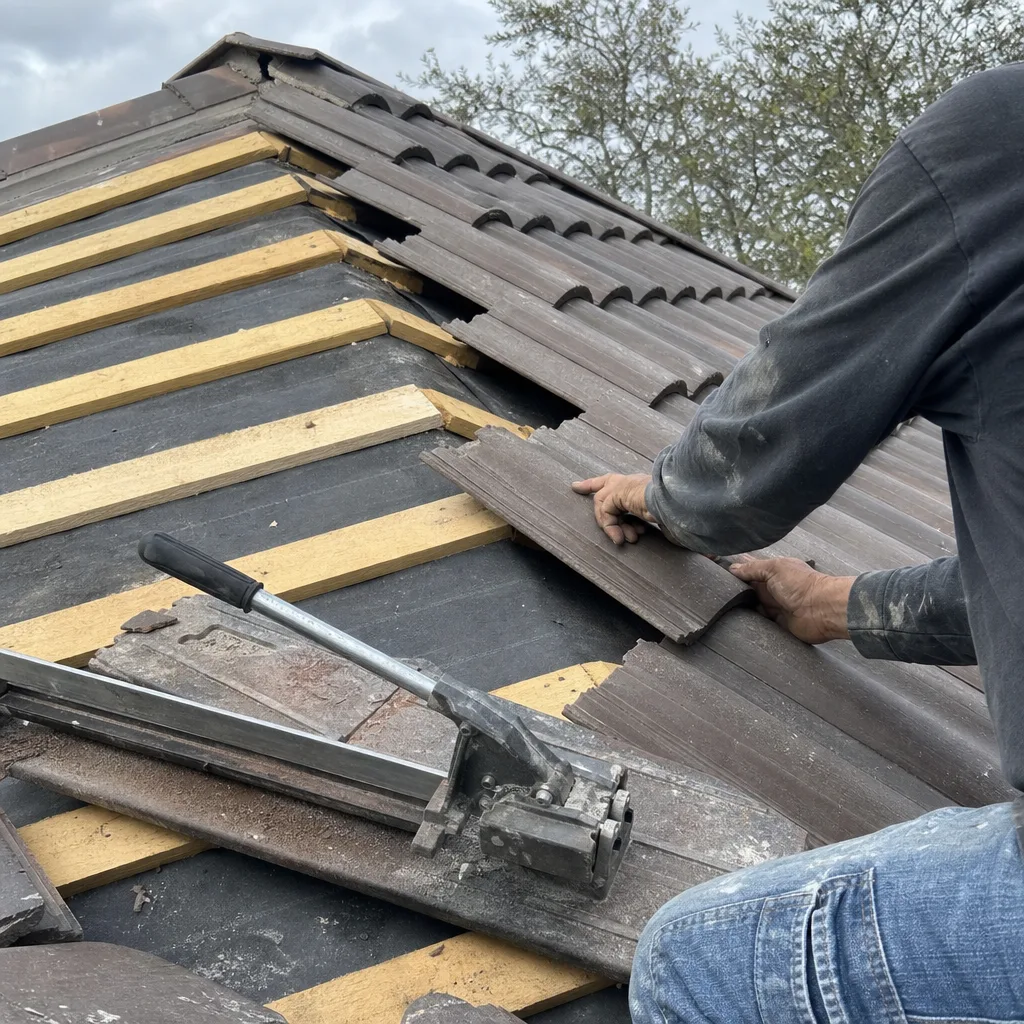
CertainTeed Flashing Replacement: The San Antonio Owner’s Guide
We stock and install CertainTeed-compatible flashing replacement across San Antonio, with most jobs running $280 to $650 installed depending on location and material. Same-day service is available when you call before noon, and our trucks carry both OEM CertainTeed flashing and approved aftermarket equivalents matched to your shingle line. Most homeowners in neighborhoods like Alamo Heights and Stone Oak first notice the problem as a water stain spreading across a ceiling after a hard rain, or they spot rust creeping along the valley where the roof meets a wall.
Which CertainTeed Models This Applies To
CertainTeed flashing isn’t one-size-fits-all. The part you need depends on your shingle series, roof pitch, and whether we’re talking step flashing at a sidewall, valley flashing in a channel, or apron flashing above a dormer.
Here’s how to identify what you’ve got. Look for the CertainTeed label on the underside of a shingle tab; the series name (Landmark, Landmark Pro, NorthGate, Presidential Shake, or Grand Manor) tells us the exposure and thickness we need to match. For step flashing, we measure the vertical leg height and horizontal projection, typically 4×5 inches or 5×7 inches on older San Antonio homes with 4:12 pitches. Valley flashing comes in W-profile or closed-cut styles, with widths from 12 to 24 inches depending on roof span.
We carry OEM CertainTeed flashing in 26-gauge and 28-gauge galvanized steel, plus 16-ounce copper for specialty applications. For most San Antonio homeowners, we recommend the OEM match when it’s available, particularly on roofs still under CertainTeed’s SureStart warranty. Aftermarket equivalents from Quality Edge and Boral save 15 to 20 percent and perform fine, but they can complicate a future warranty claim if the manufacturer wants to see their own flashing. We’ve learned that lesson on a re-inspection in Terrell Hills where the homeowner’s aftermarket valley flashing became a sticking point. We sorted it, but it took phone calls nobody wanted to make.
Signs Your CertainTeed Flashing Replacement Is Failing
- Rust spots or orange streaks on the flashing itself. Galvanized steel flashing in San Antonio’s humid subtropical climate starts losing its zinc coating after 15 to 20 years, especially where roof cement traps moisture against the metal. Once rust takes hold, it accelerates through the metal thickness in as little as two more rainy seasons.
- Water stains on interior ceilings or walls, always in the same spot after rain. This usually means step flashing has separated from the wall or the counter-flapping has slipped. The water follows the same path each time, which is why the stain keeps returning no matter how many times you repaint.
- Lifted or cracked shingles along a valley or wall line. When flashing corrodes underneath, it loses rigidity and allows shingles to flex. That movement cracks the asphalt, and cracked shingles channel water straight to the compromised metal below.
- Granule buildup in gutters below a valley or dormer. Excess granules washing out means shingles are sliding or buckling, often because the flashing beneath has warped or pulled loose. In San Antonio’s sudden downpours, that displaced water has nowhere to go but under the next course.
- Visible gaps where caulk or roof cement has dried and fallen away. Amateur repairs with tube caulk never last in our heat. The sun bakes it brittle in a single summer, and the gap behind it lets wind-driven rain straight behind the flashing. We’ve pulled off handfuls of hardened caulk on inspections in Monte Vista and seen the rot underneath.
Replacement Cost & What’s Included
| Service | Price Range (San Antonio) |
|---|---|
| Step flashing replacement (per linear foot, standard wall) | $28 - $45 |
| Valley flashing replacement (full valley, up to 20 ft) | $340 - $650 |
| Chimney saddle / cricket flashing | $380 - $720 |
| Dormer apron flashing replacement | $280 - $520 |
| Emergency tarp and temporary seal (storm response) | $150 - $280 |
What drives the range? Three things: how many courses of shingles we remove and replace to access the flashing, whether the underlying decking has taken moisture damage, and whether we’re matching discontinued CertainTeed profiles that require custom fabrication. Every estimate we write in San Antonio includes the full shingle removal, new flashing, ice-and-water shield where code requires it, shingle replacement with color match, and disposal. The number on the estimate is the number on the invoice. Our 90-Day Done Right Promise covers the workmanship, and we register any CertainTeed materials warranty on your behalf.
DIY or Call Us?
There’s a safe middle ground here. A homeowner can walk the perimeter with binoculars and spot rust, lifted shingles, or missing caulk. You can check the attic during rain for active drips, and you can photograph the problem area so we know what we’re walking into.
What you should not do is climb the roof, pry up shingles, or try to slide new flashing underneath existing courses. Roof work at height is genuinely dangerous, and flashing replacement requires removing multiple shingle courses without tearing them, seating the new metal precisely, and re-weaving the shingles so the water sheds correctly. Get the overlap wrong by half an inch and you’ve built a funnel instead of a shield. We’ve been called to fix DIY flashing jobs in King William and Lincoln Heights where the homeowner meant well but created bigger leaks than they started with.
Call (833) 756-5022 and we’ll send a background-checked, uniformed technician with a photo-documented inspection. Most flashing replacements we complete in a single visit.
FAQs
Galvanized steel flashing typically lasts 20 to 25 years in San Antonio’s climate, though we’ve seen premature failure at 12 to 15 years on north-facing slopes where moisture lingers longer. Copper flashing can go 50 years or more but costs roughly double. If your flashing is past 20 years and you’re seeing any of the symptoms above, it’s time for an inspection. Call (833) 756-5022 for a free estimate.
Patching with caulk or cement is a temporary bandage that almost always fails within one to two years in our heat. If the metal itself is sound but a single seam has opened, we can sometimes re-seal and counter-flash. Once rust is visible or the metal has thinned, replacement is the only honest fix. We don’t sell temporary repairs as permanent solutions. Call (833) 756-5022 and we’ll tell you straight which category you’re in.
Most step flashing or dormer jobs take three to five hours. A full valley replacement runs four to six hours. We complete 90 percent of our San Antonio flashing replacements in a single day, including cleanup and haul-away. You’ll get a call 30 minutes before we arrive, and we protect your landscaping while we work. Call (833) 756-5022 to schedule.
Yes. We carry 26-gauge and 28-gauge galvanized step flashing, W-valley flashing in 16-inch and 20-inch widths, and copper specialty pieces. For discontinued CertainTeed profiles or custom copper work, we fabricate overnight at our sheet metal shop. We’re an independent service provider, not affiliated with CertainTeed, but we maintain authorized installer status and stock the parts our San Antonio customers actually need. Call (833) 756-5022 to confirm availability for your specific model.
A roof either holds or it doesn’t. We build ones that hold.
If you’re seeing stains, rust, or lifted shingles anywhere your CertainTeed roof meets a wall or valley, don’t wait for the next hard rain. Call (833) 756-5022 any time, day or night. A live person answers every call, and we’ll get a technician to your San Antonio home with a straight answer and an upfront price. We’ve been standing behind local roofs since 2016, and we’ll be here to stand behind yours.
Written by Cecil Hargrove, Owner, Ridgeline Roofing Co. of San Antonio at Ridgeline Roofing Co. of San Antonio, serving San Antonio and nearby areas.